
Deed Types in St. Clair
A deed in St. Clair County does more than move land. It names the parties, sets out the legal description, and enters the transfer into the public land-record system through the recorder. The instrument type shapes what interest passes. A deed alone never promises the grantor owned everything claimed. Separate liens or easements can still attach to the parcel.
| Deed Type | What It Does | Common Use |
|---|---|---|
| Warranty deed | Conveys title with stated covenants | Ordinary arms-length transfer |
| Quitclaim deed | Conveys the interest the grantor has, if any | Entity, family, or title-cleanup transfer |
| Fiduciary deed | Conveys through authorized estate or trust action | Probate or trust administration |
| Sheriff's deed | Records a transfer following an authorized sale | Foreclosure proceeding |
| Tax deed | Documents a tax-foreclosure transfer | Delinquent-tax property |
In the county parcel sample, WD marks a warranty deed. QC marks a quitclaim deed. The recorder's books also index mortgages, liens, assignments, releases, satisfactions, easements, land contracts, plats, and condominium instruments. Each plays its own role. Look for a recorded claim and its later release. Do not assume an old mortgage still stands open.
The St. Clair Deed Index
The Recorder Public External Search serves as the county's interactive index for land records. Its coverage runs from 1984 forward. Start with a known grantor or grantee spelling, a date range, and any liber/page reference pulled from the parcel roll. Screen controls vary. Viewing document images or ordering copies may require the county's web-account or fee process.
Remember what the index is. It finds records; it does not interpret them. Open the instrument image. Compare party names, deed type, recording date, and legal description before treating a hit as the right parcel. Name variants, trusts, entities, and parcel splits can quietly break a party-name chain. The legal description carries the final word.
St. Clair's 1984 Boundary
The public search stops at 1984. For roughly February 1972 through May 1984, the Register of Deeds posts large grantor, grantee, and mortgage index-book PDFs. Grantor and grantee Books 46 through 53, plus mortgage Books 23 through 27, bridge the gap between the current portal and older office material. Open the official older-index page for those volumes.
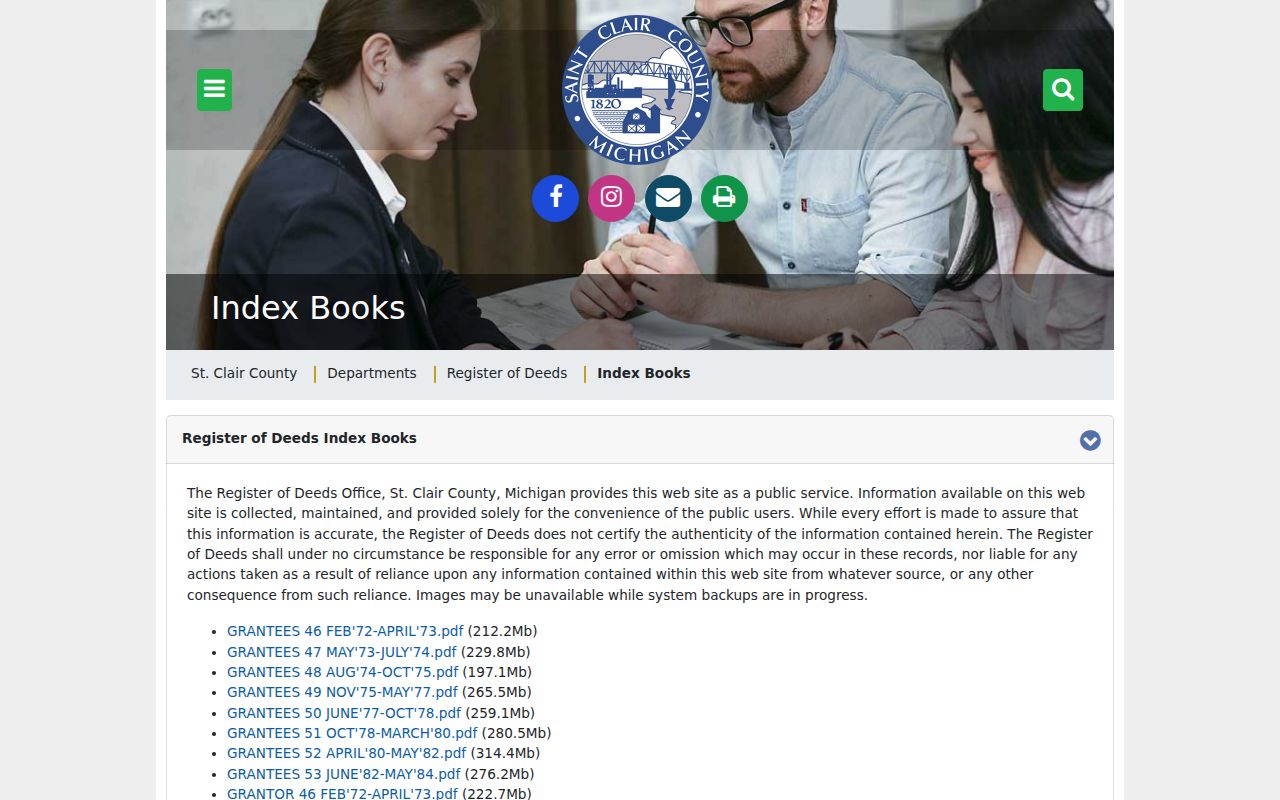
These books are scanned PDFs rather than searchable forms. Before requesting the deed, write down the book, page, party spelling, and any related instrument reference.
Note: A failed 1984-forward search says nothing about a deed that belongs in an older index book or office volume.
Walk St. Clair's Recorded Chain
A grantor conveys an interest; a grantee receives it. Start with the newest deed tied to the current parcel and read backward. The county parcel card can supply a recent party name and a liber/page lead. The deed's legal description then confirms whether the same land carried through a split, a combination, or a renamed owner of record.
- Find the current owner's acquiring deed with that owner as grantee.
- Read the grantor and exact legal description from the instrument.
- Search that grantor as an earlier grantee and verify the same land.
- Repeat, switching to PDF books or office volumes at the coverage boundary.
- Grantor
- The party conveying the recorded interest.
- Grantee
- The party receiving the recorded interest.
- Chain of title
- The linked sequence of instruments affecting the same land.
- Liber and page
- The book-and-page locator used for a recorded instrument.
A chain is more than a run of matching names. It is a sequence tied to one legal land identity. A new mailing address does not break that identity. A changed legal description, though, may point to a split, combination, condominium amendment, or partial conveyance. That kind of change reshaped the parcel itself.
A St. Clair Transfer Example
The county sample at 1721 Dove Street traces cleanly from 2003 through 2020. Its 2014 warranty-deed row names a grantor and grantee. It reports a $480,000 sale price at liber/page 4564:436. A 2020 quitclaim row points to 5222:894. The legal description cites the Assessor's Twenty-Fourth Street Plat.
The example shows how the parcel roll locates deed records without replacing them. Carry the exact parties and liber/page into the recorder index. Open the image and compare the legal description. Then follow the prior grantor backward. Note: terms like "arms length" and "mixed class" are sale-history comments. They are never title opinions or appraisals.
Condominium Deeds Need the Plan
St. Clair city examples for Pine River Club rest on Condominium Plan No. 78. Their legal descriptions cite Master Deed Liber 1235, pages 278 through 337, with a first amendment at Liber 1486, pages 634 through 637. A unit cannot be squeezed into a standard lot-and-block chain.
Keep the plan number, unit number, master-deed reference, common-element terms, and amendment references together. The master deed defines the property interest. Later unit deeds show its transfers. A GIS map can help locate the development, but it cannot replace the plan and the recorded instruments.
The county Register of Deeds records condominiums as part of its land-record duties. Michigan's state land-survey resources offer a separate final-plat search path for subdivision material from January 2019. Search the county index for the master deed and amendments first. Then connect the unit deed to those governing documents. A unit address alone may hide a changed plan name, an amendment, or a common-element interest.
Mortgages, Liens, and Releases
Deeds are only part of the job. The Register of Deeds also keeps mortgages, discharges, construction liens, tax instruments, easements, and assignments. Search by debtor or owner name, secured party or claimant, date range, and any related instrument number. Then hunt forward for its release, satisfaction, or discharge.
Match every release to the original recording reference. A name-only search can miss a merged lender, trust, or spelling variation. Court files may add foreclosure, quiet-title, or lien-enforcement context. Still, the recorded instrument stays part of the land-record chain.
A worksheet keeps the title picture clear. For each encumbrance, note the debtor, claimant, document type, recording date, liber and page or instrument number, legal description, and any later assignment or discharge. Search well past the filing date, since a release may carry a successor lender's name. An old lien against a same-name party proves nothing. The legal description and linked recording reference must tie it to the parcel.
St. Clair Property Fraud Alerts
St. Clair County offers a Property Fraud Alert service. You can sign up through the Register of Deeds information page.
A subscriber gets notice when a name hits a new filing. Alerts never stop a recording. Review the official fraud-alert link and recorder services before you enroll.
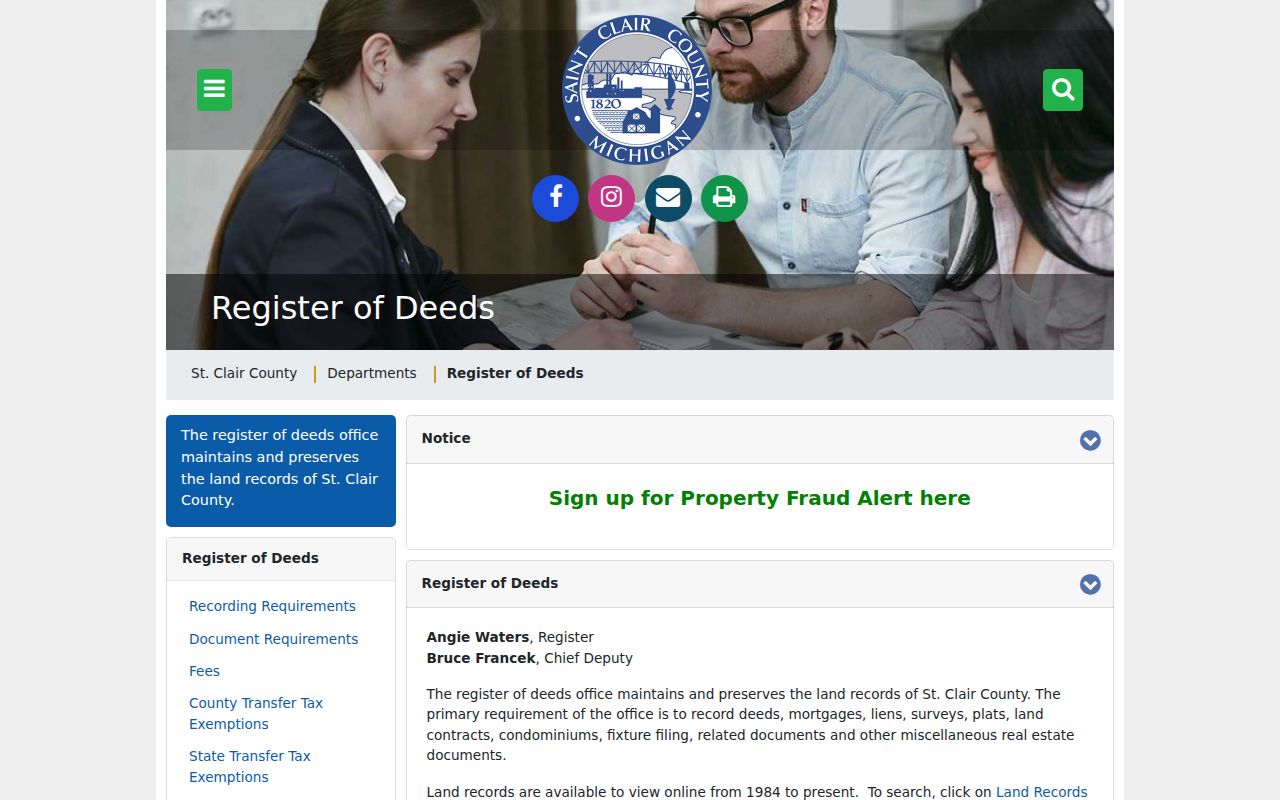
An unexpected notice deserves a closer look. Verify the parties, legal description, and recording data through the official county index, then call the Register of Deeds at its published number.
Older St. Clair Deed Research
Deed research before 1972 goes past the transition books. Ask the Recorder first. Staff can point to the right grantor or grantee volume, deed book, or microfilm reel, along with copy methods and fees. The Archives of Michigan also helps. Its St. Clair County guide locates original and microfilmed county records outside the current portal.
The County Library Michigan Room holds plats, maps, directories, newspapers, obituaries, and local histories. The Port Huron directory run starts in 1871. Those sources can pin down an address, occupant, or death date. Only the deed trail proves the recorded transfer.
St. Clair County was laid out in 1820 and organized in 1821. Early land used ranges, townships, sections, patents, and plats. The Archives guide covers R13E through R16E and T3N through T8N. Start with that land identity. Then trace forward through local deeds and tax rolls. This avoids false breaks from renamed roads, shifted boundaries, or parcel numbers invented long after the conveyance.
No record shows a courthouse fire or flood destroying county deed books. A missing web result proves nothing. Ask staff which volume, reel, or index covers the period. Save their answer with your notes.
Order a St. Clair Deed Copy
The county fee schedule keeps recording simple. Recording costs $30 no matter the page count. Ordinary copies run $1 per page, and certification adds $5 on top of copy charges. Transfer taxes and a tax certificate may cost extra. Confirm the current schedule before paying, since the request type can change the total.
Use the portal image when it serves the purpose. For an official copy, contact the Register of Deeds with the party names, recording date, instrument or liber and page reference, and legal description. The office counter and account service work when an online image is unavailable. A narrow mail request covers a known public record.
Recorded, not guaranteed. St. Clair County deed records show what reached the public index. They are not a title opinion, and unrecorded interests or indexing errors can exist.
The recording requirements page also covers signatures, acknowledgments, return addresses, margins, and land-division clauses. Recording only means the instrument met filing conditions. It does not mean the Register of Deeds judged ownership or blessed the transaction.
Michigan FOIA, MCL 15.231 et seq., covers an identifiable office record that the routine copy process does not supply, subject to exemptions and allowable charges. A focused request names the instrument, parties, date range, parcel, and desired format. The standard response period is five business days. A written extension of ten more days is possible. FOIA never makes the Recorder a title examiner. It also does not override a separate confidentiality rule.