
Build a St. Clair County Former-Owner Timeline
Work from the newest recorded deed toward older instruments. St. Clair County's interactive index reaches back to 1984, while the transition years rely on separate grantor, grantee, and mortgage PDF books.
| Transfer period | Grantor to grantee | Deed type | Book/page source |
|---|---|---|---|
| 2020 sample row | 1721 REALESTATE HOLDINGS LLC to 1721 RETAIL HOLDINGS LLC | Quitclaim | Parcel sale row, then deed index |
| 2014 sample row | Prior grantor to grantee shown on parcel detail | Warranty deed | Sale row includes price and liber/page |
| 1984-present | Search parties in reverse order | Recorded instruments | Recorder Public External Search |
| 1972-1984 | Grantor and grantee PDF index books | Deeds and mortgage index | Books 46-53; mortgage books 23-27 |
The sample sales table spans 2003 through 2020. Warranty and quitclaim entries both appear in it. Treat the rows as leads rather than a finished title chain, and tie every entry back to the recorded instrument.
Cross the St. Clair County 1984 Index Boundary
The Recorder's online coverage starts in 1984. The Recorder Public External Search reaches from that year to the present, making it the practical source for the newest previous owners, recording references, and instruments.
Coverage boundary. Before 1984, move from the interactive search to posted PDF index books and the Register of Deeds office.
Not every search field in the online index accepts a street address. Do not assume it does. Start with a grantor, grantee, date, liber and page, or a legal-description cross-reference the live interface offers.
Reconstruct the St. Clair County Deed Chain Backward
A deed chain follows parties and land identity, not just a street. Each deed should link the last grantee, the next grantor, and the same legal description.
- Find the newest deed with today's roll owner as grantee.
- Read its grantor and confirm APN or legal description.
- Search that grantor as the grantee in an earlier acquisition.
- Repeat, recording dates, deed types, and liber/page until reaching 1984.
- Continue through the older index books and office-held records.
- Grantor
- The party conveying the interest.
- Grantee
- The party receiving the interest.
- Chain of title
- The ordered series of instruments affecting ownership.
- Reverse index
- An index used to find a party by the role relevant to the prior step.
- Warranty versus quitclaim
- Different deed forms; neither sale price nor label alone proves a complete title history.
Use St. Clair County's 1972-1984 Index Books
The county Index Books page posts grantee and grantor books 46 through 53, covering roughly February 1972 into 1984. The grantee set runs to about May 1984. The grantor set stops near April 1984, and mortgage books 23 through 27 span roughly the same years.
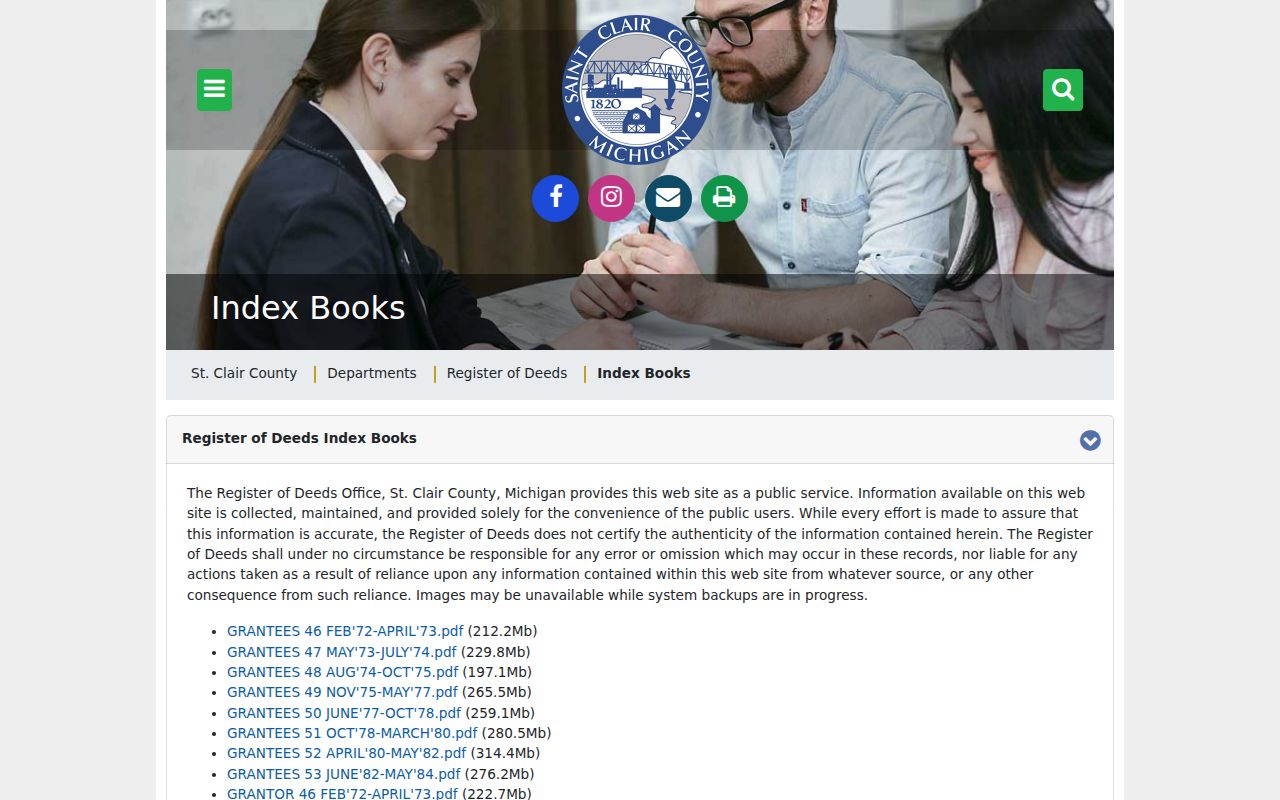
These PDFs run large. Begin with a surname and a likely year, then carry the index reference to the office or to the deed record itself.
Let St. Clair County Legal Descriptions Bridge Time
Streets get renumbered and parcels split or combine. A legal description holds up better. Subdivision plats, condominium plans, section references, and metes-and-bounds calls all preserve continuity. That stability is what carries prior-owner research across the decades.
The 1721 Dove sample, for instance, cites the Assessor's Twenty-Fourth Street Plat. Pine River Club property rests on Condominium Plan 78. Its Master Deed sits in Liber 1235, and an amendment sits in Liber 1486. Those details keep the chain on the same land when an address search fails.
A Zero Price Can Still Mark a St. Clair County Transfer
A zero price does not mean nothing happened. Quitclaims, family transfers, affidavits, and other non-arm's-length events often show no sale amount. An instrument may still sit on record. Read the deed type, parties, date, and legal description before deciding whether the row belongs in the chain.
Tax-card sale lists have gaps too. Mortgages, releases, easements, and court events may be missing, so former owners come from conveyances while other recorded interests need their own index checks.
Extend St. Clair County Previous Owners Into Local History
Older owners leave traces beyond the deed books. The St. Clair County Library Michigan Room keeps noncirculating directories, newspapers, maps, plat atlases, cemetery files, obituaries, and county histories. Its Port Huron directory holdings cover 1871, 1873, 1877-78, 1881, 1883, 1885, and 1887-88, plus a county directory from 1888.
Directories and old tax rolls are leads, not deed proof. The Register's web coverage ends somewhere. The Archives of Michigan county guide and local history groups can identify older collections and their custodians.
How Far Back St. Clair County Ownership Research Goes
Ownership research in St. Clair County falls into three tiers. Interactive deed records run from 1984 forward. Posted party and mortgage indexes cover roughly 1972 to 1984. Older land records require a visit to the recorder's office, a library, the historical society, or the Archives. No single earliest surviving deed year is published, so treat any claimed starting date with care.
Lawful use. Trace prior owners for house history and property diligence; never use public records to track, target, or harass a living person.
This sequence is not a title opinion. Liens, probate, and surveys may need review. Certified instruments settle those questions, and the St. Clair County deed records page covers obtaining an individual recorded copy.
Follow St. Clair County Previous Owners Through Probate
A death interrupts the pattern. No buyer stands across the table. The chain may then run through a fiduciary deed, an estate representative, a trust, or a court order rather than a conventional sale. St. Clair County Probate Court handles wills, estates, guardianships, and conservatorships. The Register of Deeds still preserves the instrument that changes recorded ownership.
When a former owner vanishes without a clear sale, compare the deed index with the public MiCOURT case search and the local probate file route. A docket is only a lead. The recorded deed, any certified court order, and a matched legal description establish what entered the land-record chain. Death and marriage records can support identity work. They cannot replace the conveyance itself.
Put Old St. Clair County Ownership Records in Place
Custody of older records follows local history. Robert Fulton platted the town of St. Clair in 1817. That city held the county seat until Port Huron took it over in 1871. So a nineteenth-century mention of a courthouse or clerk does not automatically mean today's Port Huron office. Check the year and the record series before assuming where a document lives.
Two outside sources help place older records. The Archives of Michigan St. Clair County guide maps county record groups and the repositories that hold them. Local historical and genealogical societies add indexes and context. Keep a research log as you work. Record the repository, series, volume, page, date, party spelling, and land description for every item you consult. That habit separates a genuine previous-owner link from a same-name coincidence.
Tax rolls and directories work best as year markers between deeds. A directory ties a person to an address. An assessment roll names the taxpayer on a parcel. But neither proves full title interest. Compare those names against grantor and grantee indexes on both sides of the target year. Newspapers, obituaries, cemetery files, and probate records can explain a family or estate handoff. They help when deed language stays terse.
Plat identity can also outlive the address. Assessor's Twenty-Fourth Street Plat in Port Huron and Pine River Club Condominium Plan 78 in St. Clair show two very different chains. One tracks lot and plat references. The other follows a master deed, plan, amendments, units, and common elements. For metes-and-bounds land, preserve the section and survey calls. Not every former-owner search fits a lot-and-block pattern.
At each step, record why the prior instrument belongs to the same land. A matching surname alone is weak evidence. A matching legal description, recording reference, adjoining parcel clue, and chronological handoff are far stronger. If a link stays uncertain, mark it as a gap. Keep going through office, library, or archive channels rather than plugging in a likely name.
The finished work should read as a sourced timeline with uncertainty left visible. Label which entries came from deeds and which came from tax or directory leads. Mark which still need a recorded-document check. That discipline keeps the chain from looking more certain on paper than the evidence supports.