
Identify Who Owns a St. Clair County Property
Start with the official Property Tax & Maps Search. It is the first public source for St. Clair County property records, letting you find the parcel by address and copy the APN before you move on to recorded documents.
- Enter the street number and name, usually without road type or direction.
- Match the situs, assessing unit, APN, and legal description.
- Read TaxPayerName and copy the latest sale's parties and liber/page.
- Confirm the latest grantee in the Register of Deeds index.
This method surfaces the public owner of record. It does not claim to reveal a trust beneficiary or every interest sitting behind an entity.
Read St. Clair County's TaxPayerName Field
On the parcel model, the current working-roll name sits in the TaxPayerName field. Owner, Owner2, and mailing fields appear alongside it. The 1721 Dove Street record shows 1721 RETAIL HOLDINGS LLC as the name. Its newest listed transfer is a 2020 quitclaim from a similarly named real-estate holding company.
| Clue | What it adds | Next check |
|---|---|---|
| TaxPayerName | Current roll presentation | Newest deed |
| APN and situs | Parcel identity | Legal description |
| Mailing address | Tax correspondence destination | Do not infer occupancy |
| Sale row | Date, type, parties, liber/page | Recorded instrument |
The field answers the ownership question on the working roll. It is not a title opinion.
Separate St. Clair County Situs From Owner Mail
A situs is where the parcel sits. The mailing address is where tax bills travel. On Dove Street, the LLC takes its mail at 1411 3rd Street, Suite F. Entities, trusts, care-of entries, and fresh transfers often create this kind of split.
Use the right clue. A public mailing line is useful contact data, but it never proves where an owner lives.
For matching records, trust the APN and legal description. A reused mailing line or a shifting street string is the weaker key.
Trace St. Clair County Property Owner Evidence
Three county sources each carry different weight. The tax search is the fastest route to the working-roll name, deed records show the recorded transfer, and the GIS map confirms the parcel on the ground.
| Source | Owner Info It Gives | Access |
|---|---|---|
| County tax roll | Owner/taxpayer, mail, APN | Public web search |
| Register of Deeds | Recorded grantee and instrument | 1984-present online index |
| Michigan business search | Registered entity information | Official state portal |
| Parcel Viewer | Tax polygon and parcel link | Public GIS |
The county publishes no fixed roll-refresh interval. So a newly recorded deed can be newer than the owner name on a working tax roll.
See a St. Clair County Owner Record in Context
The county's sample parcel detail puts taxpayer name, situs, legal description, values, and sales on one screen.
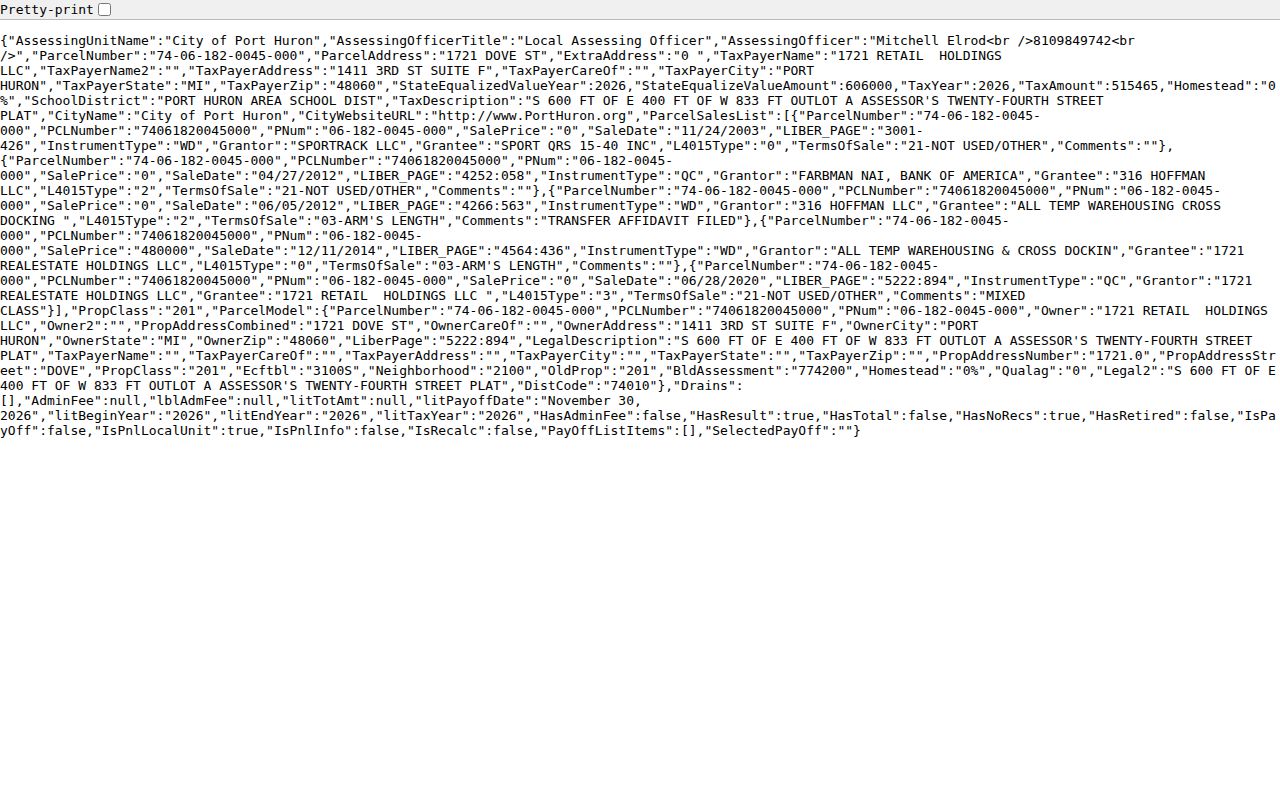
The parcel card bridges an address to a property owner quickly. For confirmation, the recorded deed still rules.
When a St. Clair County Property Owner Is an Entity
Copy an LLC or trust name exactly as written, abbreviations included. Michigan's official business-entity search can identify a registered entity. Yet it cannot prove every beneficial interest behind the land. Compare name variants against the latest grantee, the APN, and the legal description. A sale row may show a similar entity name. That may signal a related transfer rather than an unrelated property owner.
St. Clair County City Permits Add Site Context
Port Huron and Marysville run municipal BS&A pages with property or building-record routes. The City of St. Clair posts building and zoning forms instead. These address-keyed city permits explain work or use history, not title. So use them after confirming the county parcel. That matters near city-township edges, where the postal city may not match the assessing unit.
Limits When Asking Who Owns This St. Clair County Property
No online answer can guarantee beneficial ownership, clear title, surveyed boundaries, or a full lien picture. The tax roll can lag a sale. A mailing address does not establish residence. The current St. Clair County property owner guide zeroes in on verifying timing against the latest deed.
Lawful use. Public owner details support due diligence and civic use; never use them to stalk, harass, or target anyone.
For title, boundary, or lien decisions, get the actual recorded documents and professional help suited to the question.
Cross-Check a St. Clair County Property Owner With Sale History
The parcel card's sales grid lists Sale Date, Sale Price, Type, Grantor, and Grantee. Those fields test whether the owner name fits the latest visible transfer. They do not replace the instrument itself. At the Dove Street parcel, the rows run from 2003 through 2020. They include warranty and quitclaim types plus liber/page references. A 2014 row carries a price. Other transfer circumstances can produce zero or missing consideration.
Read the newest grantee against TaxPayerName. Then use the liber/page as an index anchor. If the names differ, check spelling, entity abbreviations, recording date, and the legal description. Do not assume the tax roll is wrong yet. A split or combination can move the land to a new APN too. The county says new tax IDs enter the working roll on a periodic schedule. Processing pauses during part of the equalization season. Synchronization is never instant.
Use Every St. Clair County Ownership Access Channel
The web route is only the first channel. The Register of Deeds takes real-estate copy requests by phone or email. It also serves a counter at 200 Grand River Avenue, Suite 103, Port Huron. Online public land-record coverage starts in 1984. The 1972-to-1984 party index books are posted as large PDFs. If a current deed image or an exact index field is missing online, contact the office rather than guessing.
Tax-roll corrections go to the local assessing officer or county Equalization. Port Huron runs its own assessing function. For an older address lead, the Library Michigan Room holds directories, maps, plat atlases, and newspapers. When a public record sits outside any portal, Michigan FOIA lets any person request it from the responsible public body. The response generally comes within five business days. A written ten-business-day extension is possible.
Avoid St. Clair County Property Owner Search Pitfalls
A name search in St. Clair County rarely gives one clean answer. Same-name people appear. So do spelling variants, trusts, LLCs, and care-of entries. The county permits a partial surname prefix, and its own guidance says last-name-only is often the best starting point for an individual. Treat that broad sweep as a candidate list. It is not the answer. Open each parcel and compare the physical street, the assessing unit, the APN, and the legal description before deciding which record belongs to the property you care about.
Addresses bring traps of their own. County instructions say to search with the street number and street name, dropping the road type or direction, because those elements may be shortened or missing. Ambiguity can still survive. A changed rural address or a riverfront street can return several plausible hits. Pin the parcel in GIS and keep the legal description. A postal city or ZIP will not settle local jurisdiction, because postal geography and assessment boundaries do not always match.
Parcel numbers are the most stable handle. The hyphens matter. The county displays a format such as 74-06-182-0045-000 and also accepts a shortened prefix when you want a whole group of parcels. Splits and combinations create new IDs. An older deed may cite a parent parcel instead of the current number, so compare the old and new descriptions rather than dismissing a valid instrument whose number differs from today's roll.
Owner facts and land facts are not the same. A tax amount, homestead percentage, permit, map label, or sale price adds context. None of those details alone tells you who the owner of record is. The strongest public conclusion states the owner name exactly as shown, names the source and its inspection date, and says whether the newest recorded deed agrees.
Start differently when a name came first. Search the surname prefix. County instructions allow an abbreviated first name, but a broad match will mix individuals with entities. Review every returned parcel separately. Never merge holdings just because two names look alike. The APN, situs, assessing unit, and deed grantee must each support the conclusion at the parcel level.
A tax or foreclosure clue has its own custodian. The County Treasurer administers delinquency and foreclosure, but a tax payment page will not name every private interest or confirm the vesting deed. Circuit or Probate records can explain a court-ordered or estate transfer. The recorded deed or certified order still has to be matched to the land. Know which office answers which question. Keeping those roles separate sharpens the ownership answer.
Old addresses need translation. City directories, plat atlases, and historic tax material can turn an old street address into a party name or a legal description. Those finds should feed the county deed search, not replace it. A modern permit works the same way. It connects work to an address. It cannot tell you who held title on the date the work was done.