
Inside St. Clair County Property Tax Records
The county parcel card keeps several figures separate, and that distinction matters. You might review a purchase. You might check an assessment notice. You might even match an old tax roll to a deed. Each task depends on knowing which number is which. St. Clair County property tax records also name the assessing unit and school district. That routing detail helps a question reach the right local office fast.
| Field | What It Shows | Where |
|---|---|---|
| Assessed value / SEV | Assessment-year value under Michigan's 50 percent true-cash-value framework | Parcel detail and local assessor |
| Taxable value and tax amount | The distinct base and charge used for the tax year | Parcel detail and tax roll |
| Homestead percentage | A roll indicator, not proof that a named person lives at the site | Parcel detail |
| Delinquency status | Whether unpaid taxes have moved to county collection | County Treasurer |
| Sale history | Dates, prices, deed type, grantor, and grantee | Parcel detail, then deed index |
Assessed value is not a sale-price prediction. Taxable value can differ from SEV. Michigan's Proposal A limits annual growth until a transfer uncaps taxable value in the following calendar year. A recorded sale price, meanwhile, is a separate field altogether.
Search St. Clair County Tax Records With One Key
The official Property Tax & Maps Search runs one criterion at a time. Pick the clue least likely to have changed, then copy the APN from the result.
| Search choice | How St. Clair County accepts it |
|---|---|
| Owner name | A surname prefix works; add a space before an optional first name. |
| Street | Enter street number and street name, usually without road type or direction. |
| Parcel number | Keep the hyphens; a prefix such as 74-20-006 may return a group. |
St. Clair County's official search page opens every property tax records lookup.
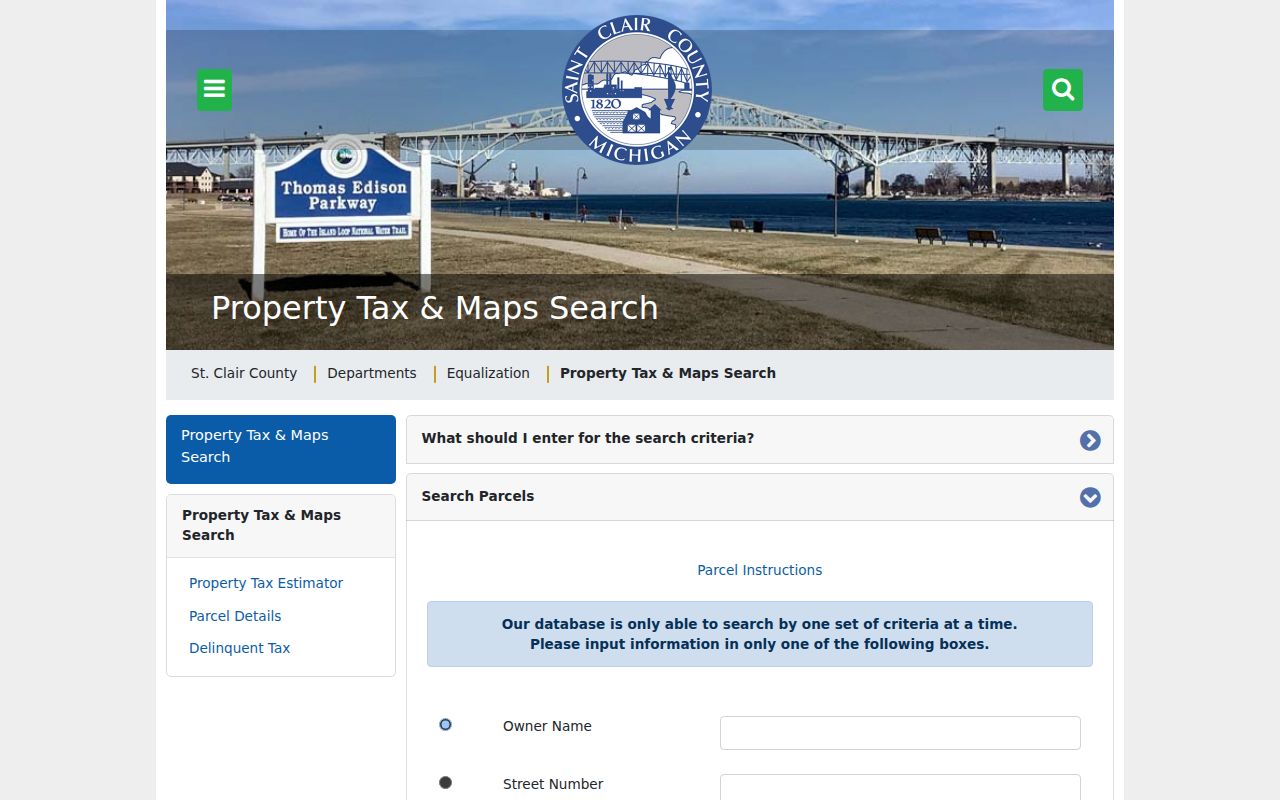
The parcel number is the most stable bridge among tax, GIS, and deed sources. The same page can link onward to map, aerial, drain-assessment, and delinquent-tax actions tied to the parcel.
St. Clair County Taxpayer Mail Can Point Elsewhere
The situs address marks the physical parcel. The taxpayer mailing address marks where tax correspondence goes. Those two lines can differ for an LLC, a trust, a care-of entry, a commercial holding, or a recent transfer. The 1721 Dove Street parcel, for example, names an LLC as owner while its tax mail goes to 1411 3rd Street, Suite F.
Reading tip. Treat a mailing address as a public-record lead, never as proof that the owner occupies that place.
Because of that mailing-versus-situs split, match St. Clair County property tax records by APN and legal description. A mailing line alone can mislead.
Follow a St. Clair County Property Tax Bill
A current parcel search identifies the record and links into tax resources. Delinquent amounts and foreclosure status belong with the County Treasurer. An assessment question, by contrast, belongs with the local assessing officer.
- Search by address and record the parcel number, assessing unit, tax year, and SEV year.
- Read the tax amount and taxable-value presentation without treating either as market value.
- Check the homestead percentage and ask the local assessor about an incorrect roll flag.
- Use the County Treasurer for delinquency, payment, or foreclosure questions.
- Assessed value
- The roll value used to establish SEV under Michigan assessment rules.
- Taxable value
- The separate figure to which tax rates are applied.
- Homestead indicator
- The parcel card's percentage field, which is not conclusive occupancy proof.
- Tax lien
- A public claim tied to unpaid property tax, distinct from a private mortgage.
St. Clair County Property Tax Payment Channels
The Treasurer accepts payment online, by mail, and through the office door drop. ACH carries no fee. Card payments carry a 2.75 percent charge. Counter hours are Monday through Friday, 8:30 a.m. to noon and 1 to 4 p.m. The counter sits at 200 Grand River, Suite 101, Port Huron.
Delinquent taxes for 2021 and older run through this office. The office administers foreclosure under PA 123 of 1999. One caution stands out. Partial payments are not accepted in March for parcels ordered to foreclose on March 31. Archived 2024 and 2025 tax-roll PDFs give annual snapshots by city, township, and village.
What St. Clair County's 2026 Equalization Total Means
The Equalization Reports page links the 2026 county report. It lists a county equalized value of $12,426,680,232 for 2026, up from $11,612,570,293 for 2025. That is a 7.01 percent change. The headline figure excludes industrial facility tax abatement and DNR values.
Treat the countywide number as context, never as an estimate for one house. Individual St. Clair County property tax records can move differently. The drivers vary by class, local unit, physical changes, transfers, and assessment history.
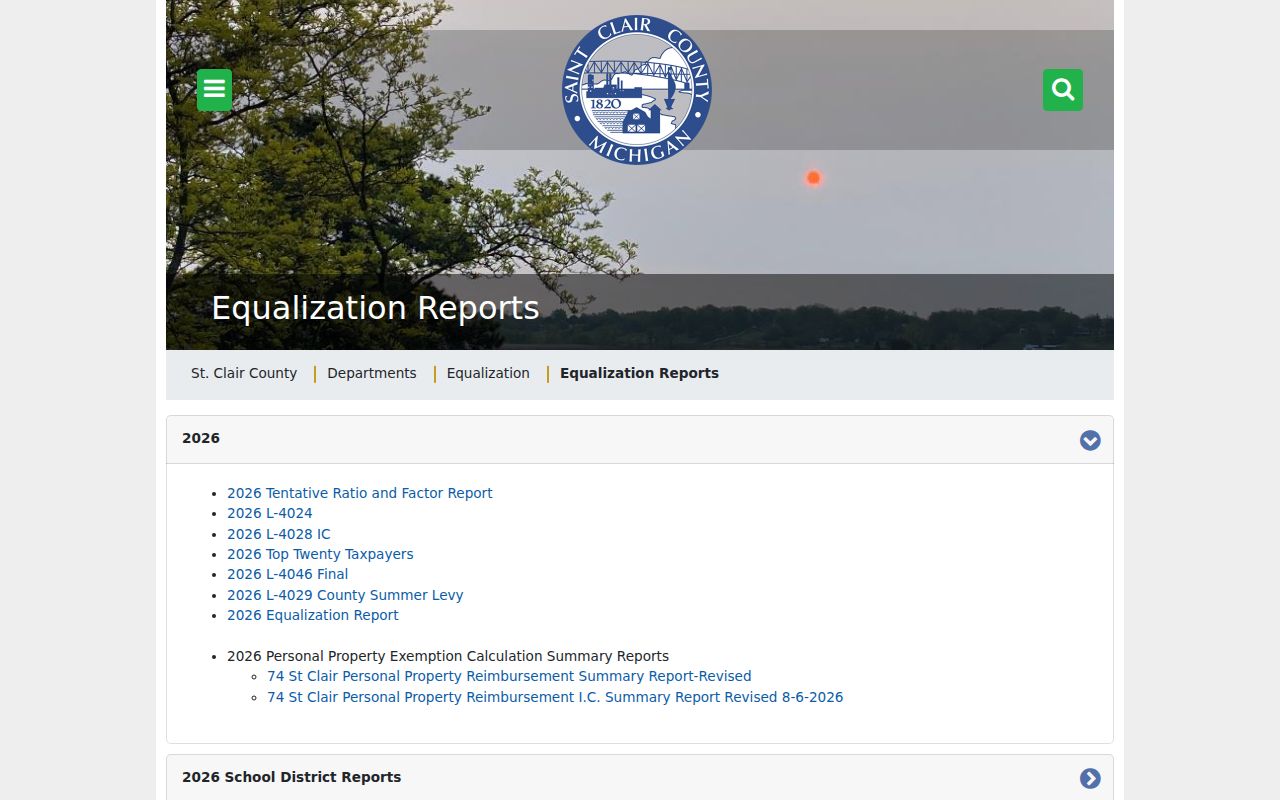
St. Clair County's official report details every figure behind the equalization total.
Local Assessors Set St. Clair County Parcel Values
The local city or township assessing officer sets each assessment first. St. Clair County Equalization then handles the broader work: annual appraisal and sale studies, equalization factors, and roll updates that carry names, addresses, and land descriptions. Port Huron stands apart, since it runs its own assessing function instead.
Need a record corrected? Start by finding the assessing unit listed on the parcel card. Equalization staff can walk through county processes at 810-989-6925, but any parcel-level dispute goes back to the local assessor who keeps that roll.
Contest a St. Clair County Property Assessment
Start with the assessment notice and the local assessing officer. Then follow that unit's review process. Local assessors and county Equalization each play a defined role, but there is no single countywide appeal date or one form covering every city and township. Do not borrow a deadline from another Michigan unit.
Confirm the window. Ask the assessing unit shown on the parcel card for its current board schedule, filing deadline, and required form.
Useful evidence includes the parcel record and correct property characteristics. Recent relevant sales and documents showing an error help too. The goal is to challenge the assessment with the body that set it, not to treat the Treasurer's bill as the assessment decision.
Reconcile St. Clair County Tax Records Across Years
A live parcel page and an archived roll answer different questions. The current record keeps changing. Names, land descriptions, values, and new tax IDs get posted as updates arrive. The Treasurer's archived 2024 and 2025 rolls are fixed PDFs. They are organized by city, township, and village. Someone may need proof of what an earlier tax year showed. The archived unit roll for that year may preserve entries the current screen presents differently. St. Clair County property tax records therefore serve two distinct purpose depending on the date in question.
Before trusting a name match, line up the APN, the assessing unit, and the legal description. A parcel split can retire one ID and issue several new ones. A combination does the opposite, folding earlier identities into one. The county's land-division materials describe the sequence. Local approval comes first. County processing follows. Only then do new IDs join the working roll. The same materials note a spring processing pause. That timing alone can explain a temporary mismatch. A recorded survey, the parcel polygon, and St. Clair County property tax records may disagree for a while. A discrepancy like that is not evidence of an office error.
Delinquency runs on its own clock. The Treasurer handles county delinquent-tax and foreclosure processes. The office also posts annual auction information. Current local taxes often sit with a city or township first. They transfer to the county later. Check the tax year in the record. Identify which office holds it. A March foreclosure notice or an auction listing never substitutes for the parcel's actual status. Keep the details together in one place. That means the parcel number, tax year, amount, search date, and the office's response.
A two-year comparison should not be mistaken for a measure of market appreciation. Look at several fields. Check SEV, taxable value, and homestead percentage. Review physical additions or removals, any transfer, and the local unit. The county equalization report tracks movement across broad classes and the county as a whole. It cannot explain one parcel's result. A careful comparison names each field and each year on its own.
Limits of St. Clair County Property Tax Records
A tax card has firm limits. It certifies no title. It fixes no surveyed boundary. It reveals no guaranteed list of liens. It stands in for no appraisal. Think of its sales row as a bridge to the Register of Deeds. The recorded instrument and legal description can be checked there. A zero or blank price often signals a quitclaim or a transfer between related parties. It is not a missing owner of record.
Note the date of any search, since working rolls change. For assessed value versus sale price, the St. Clair County property value guide goes deeper. For the bill, exemptions, delinquency, and appeals, the taxing offices above remain the right stop.
The county's sample inventory shows why one number can never stand in for the whole record. A single parcel detail may carry an SEV year and amount, a building assessment, a tax year, a tax amount or taxable-value figure, a homestead percentage, a school district, a legal description, a property class, and a neighborhood. It may also carry sale rows. Read the label and year beside every amount before comparing parcels. A shift in the tax bill may come from more than land or building value. A transfer can also move taxable value under Michigan law. Archived rolls answer what a taxing unit published for an earlier year. The current portal is the better starting point for a live parcel. If either source conflicts with a deed or a notice, keep copies. Ask the local assessor or Treasurer which record controls the issue.